
Last week I had the chance to attend the informative and insightful EA Innovation Forum, where Dylan Wiliam delivered a thought provoking keynote on formative assessment. His message was direct and timely: – better formative assessment starts with abandoning weak routines and replacing them with strategies that reveal the understanding of every learner.
How to do this:
- Gather evidence from all pupils, not just the most confident voices, because relying on a few hands up gives weak evidence.
- Use short‑cycle assessment, check for understanding every few minutes through questioning, discussion, and observation.
- Strengthen success criteria, making them clear and specific so pupils understand what quality looks like.
- Give feedback that leads to action, ensuring pupils do something with feedback rather than simply receiving it.

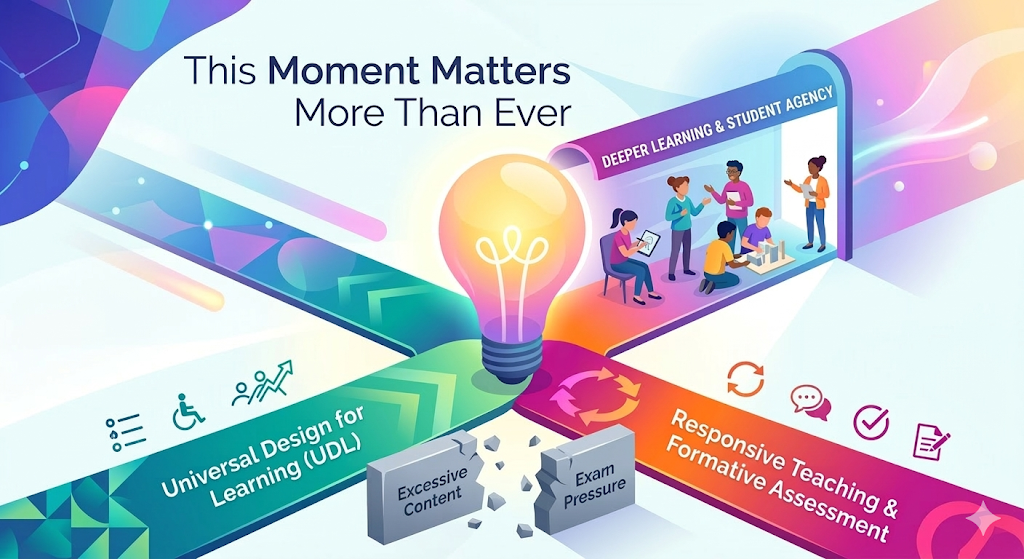
The context in Northern Ireland is shifting. With CCEA moving toward reduced GCSE and A‑level content, the focus is moving away from racing through specifications and towards giving pupils time for deeper learning. And if we’re serious about that shift, then strengthening formative assessment and embedding UDL (Universal Design for Learning) aren’t optional add‑ons, they become the foundation for how learning happens.
Rather than leaning on the broad and sometimes vague term formative assessment – a phrase everyone uses but few apply with real depth – Dylan Wiliam argues that what truly matters is responsive teaching: gathering evidence from every pupil, every day, and using it to adjust what happens next. To make this distinction clearer, I’m going to use the phrase “responsive formative assessment” to separate the everyday label from the deeper practice Wiliam describes.
Why Reduced Content Creates Space for Better Learning
The recent consultation on the future of CCEA qualifications highlights something teachers have felt for years: specifications have become bloated, overly exam‑driven, and too often lead to teaching to the test rather than genuine understanding.
Stakeholders consistently pointed out that:
- Excessive content restricts deeper learning.
- Pupils are under intense pressure from constant exam cycles.
- Teachers are squeezed for time, forced to rush rather than explore.
- Assessment dominates the curriculum instead of supporting it.
The upcoming shift to less content and fewer assessments needs to give teachers time back time for – discussion, exploration, skill‑building, problem‑solving, collaboration and creativity… in short:
💡 The kind of learning responsive formative assessment is built for.
💡 The kind of learning UDL helps make possible for every student.
Where UDL Naturally Meets Responsive Formative Assessment
No learning happens without engagement.
That is exactly where UDL comes alive.
UDL isn’t about “making things easier” – it’s about removing barriers so every learner can engage, understand, and express their learning.
Let’s break down the overlap.
1. UDL drives engagement → responsive formative assessment requires engagement
If learners aren’t engaged, the feedback loop is broken before it even starts.
UDL helps activate motivation through:
- choice
- relevance
- multiple modes of engagement
- reduced cognitive load
This means students are actually ready to learn – making feedback actionable.
2. UDL offers multiple ways to show learning → responsive formative assessment needs rich evidence
Traditional assessment tends to default to writing, but:

UDL encourages multiple means of action and expression, which naturally generates more varied, accurate evidence of learning far beyond a written test.
Formative assessment becomes more accurate, more inclusive, and more meaningful when students can show what they know in multiple ways.
3. UDL removes barriers → responsive formative assessment exposes and addresses them
One of the most powerful parts of the consultation report was the acknowledgement that current assessment approaches often:
- Create unnecessary pressure,
- Narrow teaching,
- and limit what learners can demonstrate.
UDL’s proactive approach – anticipating barriers before teaching even starts – creates the conditions where formative assessment is honest, fair, and genuinely reflective of student understanding.
Why This Moment can be a Turning Point
The proposed changes to GCSEs and A‑levels means less content, fewer assessments, reduced controlled assessment, and more space for teaching. This opens a unique opportunity.
For the first time in years, we are being given permission to slow down:
- To go deeper,
- To embed feedback cycles that actually improve learning,
- To design learning experiences that are accessible from the start,
- To use technology as a support – not a crutch,
- To help pupils develop the wider competencies that excessive assessment crowds out.

Final Thoughts
As content reduces and hopefully teaching time expands, the real challenge shifts from
“How do I fit everything in?”
to:
“How do I design learning that is accessible, meaningful, challenging, and evidence‑rich?”
That’s a challenge worth embracing and one that will define the next era of teaching and learning in Northern Ireland. UDL and better formative assessment together can provide the roadmap.
If we get this right, learners won’t just perform better in exams.
- They’ll think better.
- They’ll understand more deeply.
- They’ll own their learning.
And that is the real transformation Educators want for their students.
39. Boosting Home Engagement with UDL and Microsoft Teams Classwork
Leave a Reply